Genco Abbandando
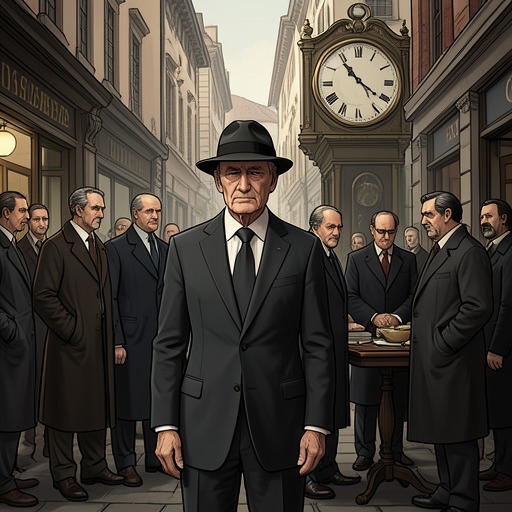
The GodfatherGenco Abbandando is the trusted friend who links Vito Corleone's immigrant beginnings to the mature organization of the Corleone Family. First encountered as a boyhood companion in New York, he becomes Vito's partner in the Genco Pura Olive Oil Company, the family's counselor, and finally the dying friend whose vacant office passes to Tom Hagen. His importance lies less in spectacular action than in the way his loyalty, business competence, and place within a carefully insulated hierarchy make personal bonds function as an institution.
Identity and Background
Genco Abbandando's family receives Vito Corleone when the twelve-year-old refugee arrives in America after his father is murdered in Sicily and local Mafia gunmen begin looking for the boy. Vito is boarded with the Abbandandos and goes to work in their grocery store on Ninth Avenue in New York's Hell's Kitchen. The household therefore becomes part of the foundation of his American life, while Genco himself grows from an adopted-family connection into Vito's closest professional ally.
By the time Vito has established himself, Genco is associated with practical knowledge, continuity, and trust. His relationship with Vito predates the Corleone empire and carries the authority of shared origins: he is not merely an employee who rises through the ranks, but the friend who knew Vito before wealth, power, and the title of Don transformed him. That background explains why Vito treats the relationship as a lifelong obligation rather than a disposable business arrangement.
Business Partnership and the Building of Power
When Vito decides to enter the olive-oil importing business, Genco takes responsibility for the commercial work that Vito lacks the experience to perform directly. He imports the oil from Italy, buys it at the proper price, and stores it in his father's warehouse. Peter Clemenza and Salvatore Tessio sell the product to Italian grocery stores across Manhattan, Brooklyn, and the Bronx, while Vito supplies most of the capital and intervenes when persuasion is required. The company is named Genco Pura Olive Oil rather than after Vito, an act of modesty that also allows the enterprise to bear the name of the partnership's practical center.
Genco's contribution is therefore structural as well as commercial. The expanding company gives Vito a legitimate-looking economic base, a distribution network, vehicles, contacts, and a reason to cultivate relationships throughout the Italian neighborhoods. As the business grows into America's bestselling imported Italian oil, Vito uses competitive pricing, control of distribution outlets, and mergers to press toward monopoly. Genco's importing, storage, and purchasing work makes that expansion possible, while Vito's personal authority handles resistant retailers and the less visible obligations surrounding the enterprise.
Genco also helps convert informal influence into a functioning system. When police stops threaten the trucks, he hires a lawyer with contacts in the Police Department and the judiciary, allowing the organization to establish a payoff list for officials receiving monthly sums. Later, as the number of trucks, soldiers, and outside obligations makes the organization unwieldy, Vito appoints Genco as Consigliere and places layers of insulation between himself and operational acts. Genco thus stands between the Don's policy and the men who carry out orders, serving as counselor, intermediary, and protective buffer.
Consigliere and the Logic of Loyalty
The office of Consigliere is presented as more than an administrative title. It is the Don's right-hand position, his auxiliary brain, closest companion, and closest friend. The Consigliere drives the Don's car on important journeys, obtains refreshments and cigars at conferences, and knows nearly everything the head of the Family knows. Because he understands the whole network of power, he is also the one person capable of bringing the Don down—yet the office rests on the expectation that faithfulness will be rewarded with wealth, authority, respect, and protection for the Consigliere's family.
Genco's appointment embodies this older model of authority. The Corleone organization depends on friendship, debt, and personal confidence, but it also depends on the ability to hide the source of an order. Vito gives instructions privately to Genco or to a caporegime; the next link passes them onward; the final men may never know who originated the command. In this arrangement, Genco's trustworthiness is a security mechanism. His closeness to Vito does not weaken the organization because the office has been made part of its insulation.
That same system appears beyond the Family's immediate operations. Vito's dealings with labor leaders, lawyers, bankers, and other indebted associates rely on relationships that substitute for formal guarantees. At the peace meeting among the Families, a bank president who holds shares belonging to Vito offers written proof of the arrangement, but Vito rejects the gesture as an insult to their mutual trust, explaining that betrayal would destroy his faith in his judgment of character. Genco belongs to this moral economy of confidence: the network works because friendship is treated as both emotional bond and enforceable obligation.
Illness, Death, and Succession
Genco's final appearance is shaped by a long illness rather than a public act of power. Cancer has confined him to a hospital bed for nearly a year, and Tom Hagen has performed the Consigliere's duties during that period. On the day of Constanzia Corleone's wedding, Vito leaves the celebration to visit his old friend. Genco's wife and three daughters, dressed in black, surge toward Vito for protection, while his wife calls him a saint for coming on such an important day. Vito answers not with self-congratulation but by insisting that he owes respect to a friend who has been his right arm for twenty years.
Inside the private room, Genco lies wasted almost to a skeleton, his once vigorous black hair reduced to stringy wisps. Vito brings Santino Corleone, Fredo Corleone, and Johnny Fontane to pay their respects, and Genco gratefully allows the younger men to hold his hand. Vito speaks to him as if the future remains open, promising that they will recover and return to their old village in Italy to play bocce in front of the wine shop as their fathers had done. The imagined journey preserves their shared past even as the physical scene makes clear that Genco is dying.
Genco dies at three in the morning. After returning from the hospital, Vito informs Tom Hagen that Hagen is now officially the new Consigliere. The promotion makes Hagen certain to become a rich and powerful man, but it also breaks a longstanding rule: the office has traditionally belonged to a full-blooded Sicilian born to the ways of Omertà, the law of silence. Hagen's upbringing within Vito's family has not erased the objection that he is not Sicilian by blood, and his age and temporary service have already caused unease. Genco's death therefore creates an institutional crisis as well as a personal loss.
Narrative Significance
Genco Abbandando represents the first generation of Vito Corleone's power: immigrant friendship, neighborhood commerce, reciprocal protection, and a belief that loyalty can organize a world more reliably than official institutions. His career shows how the Corleone Family grows through overlapping networks rather than through violence alone. The grocery store, the olive-oil warehouse, the legal contacts, the police payoff list, and the Consigliere's confidential channel all belong to one expanding social system in which business and friendship are inseparable.
His death also exposes the limits of that system. The office he leaves behind is powerful precisely because it is personal, yet its succession cannot be settled by personal affection alone. Tom Hagen possesses Vito's trust and has already performed the work, but blood, tradition, and the changing demands of the organization challenge his appointment. Genco's passing thus closes an old circle around Vito while opening the question of whether the Family can preserve its authority by relying on inherited customs or must adapt its structure to a broader, more modern network.